
Student Experience Development Project
Service Design / June-December 2025
LAB Institute of Design and Fine Arts.
How might we make the student experience clearer, more connected and easier to navigate?
A service design project exploring how LAB could strengthen the student experience across information, communication, community and everyday services.
My Role
I worked as a Service Designer alongside my colleague Tytti Leppänen, contributing to the project from research and synthesis through co-creation, concept development and prioritization.
My role combined research, facilitation and hands-on service design. I helped turn a broad and complex development challenge into concrete opportunities and practical concepts that could be explored with students and staff.
The Challenge
LAB students interact with a complex network of services, digital platforms, communication channels and people throughout their studies. While information and support were available, the overall experience was not always easy to navigate.
The challenge was to understand where students experienced friction in their everyday journey and identify opportunities to make the experience clearer, more connected and engaging.
Rather than focusing on a single service or touchpoint, the project looked at the student experience as a broader service ecosystem.
Student experience — mapping the different services, interactions and touchpoints that shape everyday student life.
Research & Approach
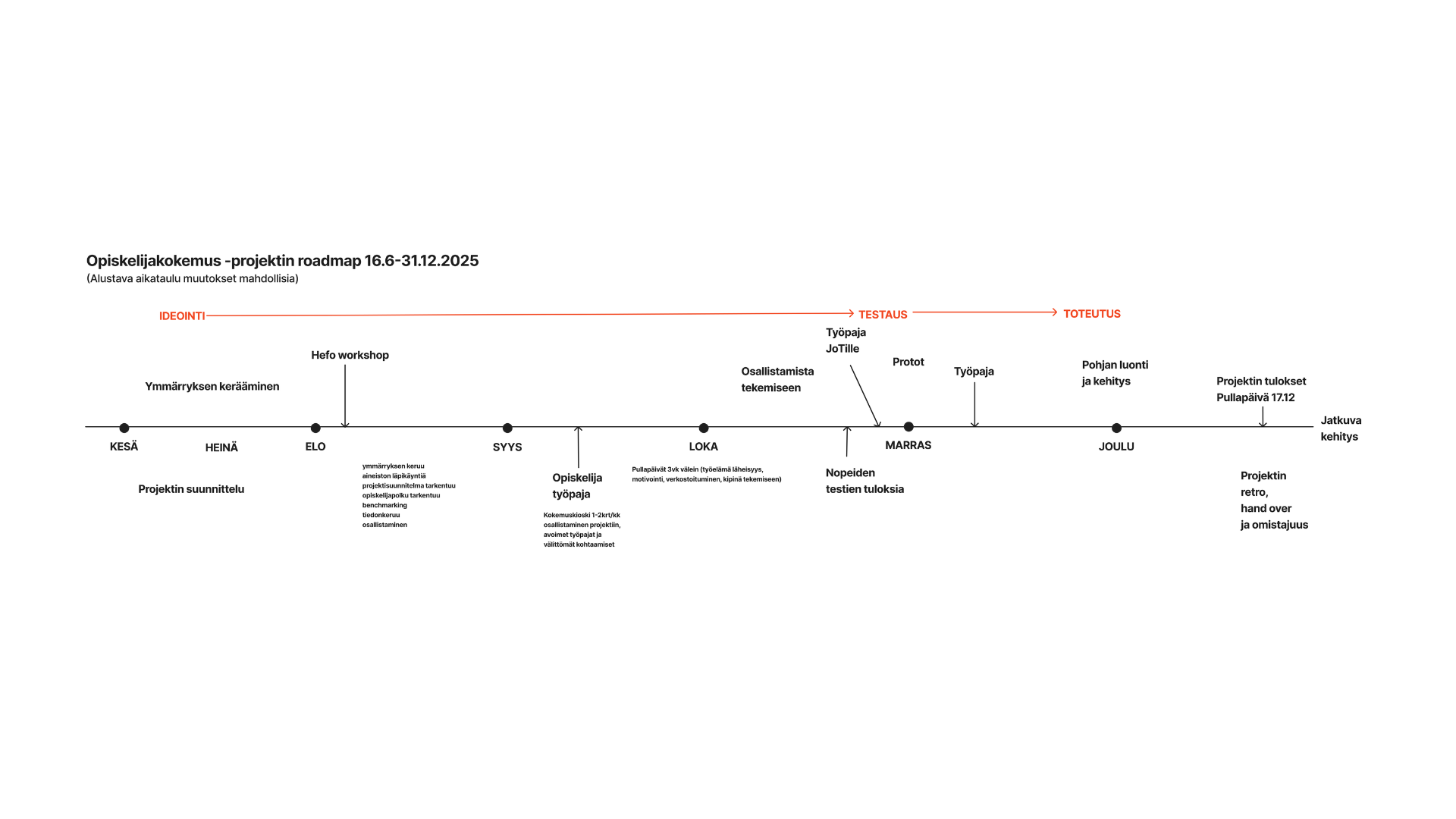
The project built on existing research, student feedback and an understanding of the current student experience. The aim was to combine existing knowledge with direct observation and co-creation to identify meaningful opportunities for development.
The work included:
Reviewing existing student feedback and research
Mapping practices, processes and digital environments affecting student life
Exploring the end-to-end student journey
Validating emerging themes through workshops, informal encounters and observations
Synthesizing qualitative material to identify recurring themes, pain points and development opportunities
Understanding the Experience
The student experience was not defined by a single issue. It varied across different parts of the student journey, with the quality and accessibility of support depending on the situation, service and people involved.
Students valued clear teaching, approachable support, practical learning and a strong sense of community. At the same time, the experience could become difficult to navigate when responsibilities, information or opportunities were unclear — for example in study planning, tutoring, work-life connections, international opportunities and communication.
Looking at these experiences together revealed a broader pattern: many individual challenges were connected not only to individual services, but to how consistently the different parts of the student experience worked together.
Key Insights
1 Support should be proactive, not something students have to know how to ask for
Students value personal guidance, but access to it can depend on knowing who to approach, what to ask and when to ask. This is particularly visible in tutoring, HOPS guidance, internships and career planning.
The issue is not simply the availability of support, but how clearly the student understands where support exists and how to access it.
2 The student experience depends heavily on people and interactions
Students describe approachable, knowledgeable and responsive teachers as a major part of a good learning experience. Personal interaction, feedback and the feeling of being heard can have an impact beyond an individual course.
This also creates variation: when the experience depends strongly on individual people, students may receive very different levels of support.
3 Students want education to connect more clearly with the world outside school
Work-life connections, visiting professionals, company collaboration, internships, portfolios and career planning repeatedly emerge as important. Students particularly value situations where they can hear from professionals and understand what working in the field actually looks like.
The desire is not simply for more information about working life, but for more concrete and timely encounters with it during studies.
4 Internationalisation needs to be part of everyday studies, not a separate opportunity
International opportunities are appreciated, but they can remain distant from students who are not actively applying for exchange or international courses. Students suggested that international students, courses and projects could be integrated more naturally into everyday studies.
The challenge is therefore not simply the availability of international opportunities, but their visibility and accessibility in everyday student life.
5 Flexibility works when it is supported by structure and interaction
Students see clear benefits in both campus and online learning. Online studies can provide flexibility and enable workshops and small-group work, while campus teaching offers interaction, immediate support and connection with other students. Poorly structured online courses, however, can leave students studying alone without sufficient guidance.
This suggests that the question is not campus vs. online, but what kind of learning experience each format enables.
6 Students experience the school as a system, not as separate courses and services
Across the findings, many challenges appear connected: unclear communication, HOPS and tutoring, work-life opportunities, internationalisation, course structures and student support. Information may exist, but students can still struggle to understand how the different parts fit together.
At the same time, the strongest experiences — good teaching, community, support and practical learning — reinforce one another.
Posters designed by Tytti Leppänen.
Kuusijuhla invitation designed by Tytti Leppänen.
From Insights to Opportunities
The insights revealed that the challenges were interconnected rather than isolated issues. This shifted the focus from fixing individual problems towards exploring opportunities that could improve the wider student experience.
We translated the insights into design opportunities by asking how existing services, interactions and resources could work differently — and where new ways of supporting, connecting and engaging students could create value.
Design Opportunities
The research and co-creation work resulted in 19 prioritized development proposals addressing different aspects of the student experience.
The proposals explored opportunities to improve information and guidance, strengthen connections with working life and the wider community, support learning and participation, and create a more coherent everyday experience for students.
Rather than presenting all 19 proposals individually, four examples illustrate the range of opportunities explored:
Yhden oven takana
A concept for simplifying access to the many channels and services students use during their studies.
Students currently navigate between multiple platforms and communication channels, including Moodle, Tuudo, Viva Engage, Teams, email, Peppi and eLAB. The fragmented experience can make information difficult to find and create unnecessary effort in everyday studies.
Yhden oven takana explored the idea of bringing the most important information, links, tools and guidance together behind one login and one clear view.
The concept aimed to reduce the burden of navigating between channels, make information easier to find and create a more coherent digital experience for students. The proposed solution would require technical integration, development resources and organisational-level decisions.
Minusta tämä on nyt paljon parempi kuin aiempi versio, koska se perustuu suoraan kortin sisältöön eikä lisää siihen mitään ylimääräistä.
Kokemuskioski
A low-threshold format for bringing student feedback and co-creation into everyday campus life.
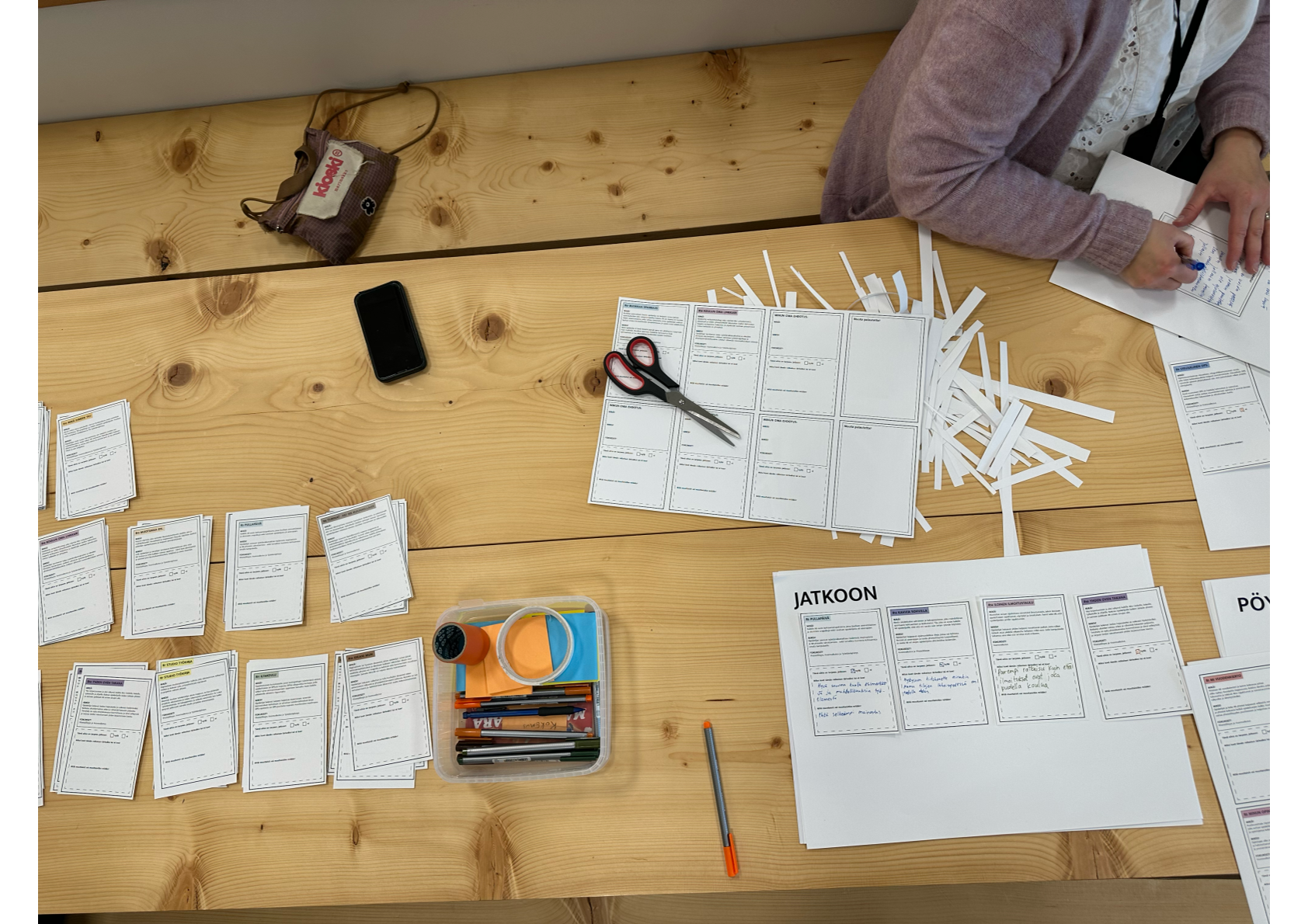
We designed and facilitated Kokemuskioski, an on-campus, walk-in format where students could share experiences, discuss challenges and contribute ideas without registration or prior preparation.
The kiosk used guided conversations, simple tasks and visual tools to make participation easy and approachable. The format was designed to reach students beyond those who typically participate in formal feedback activities.
The conversations generated qualitative insights and development themes that supported subsequent workshops, concept development and prioritization. Kokemuskioski demonstrated how creating a space for informal dialogue can bring student perspectives closer to everyday service development.
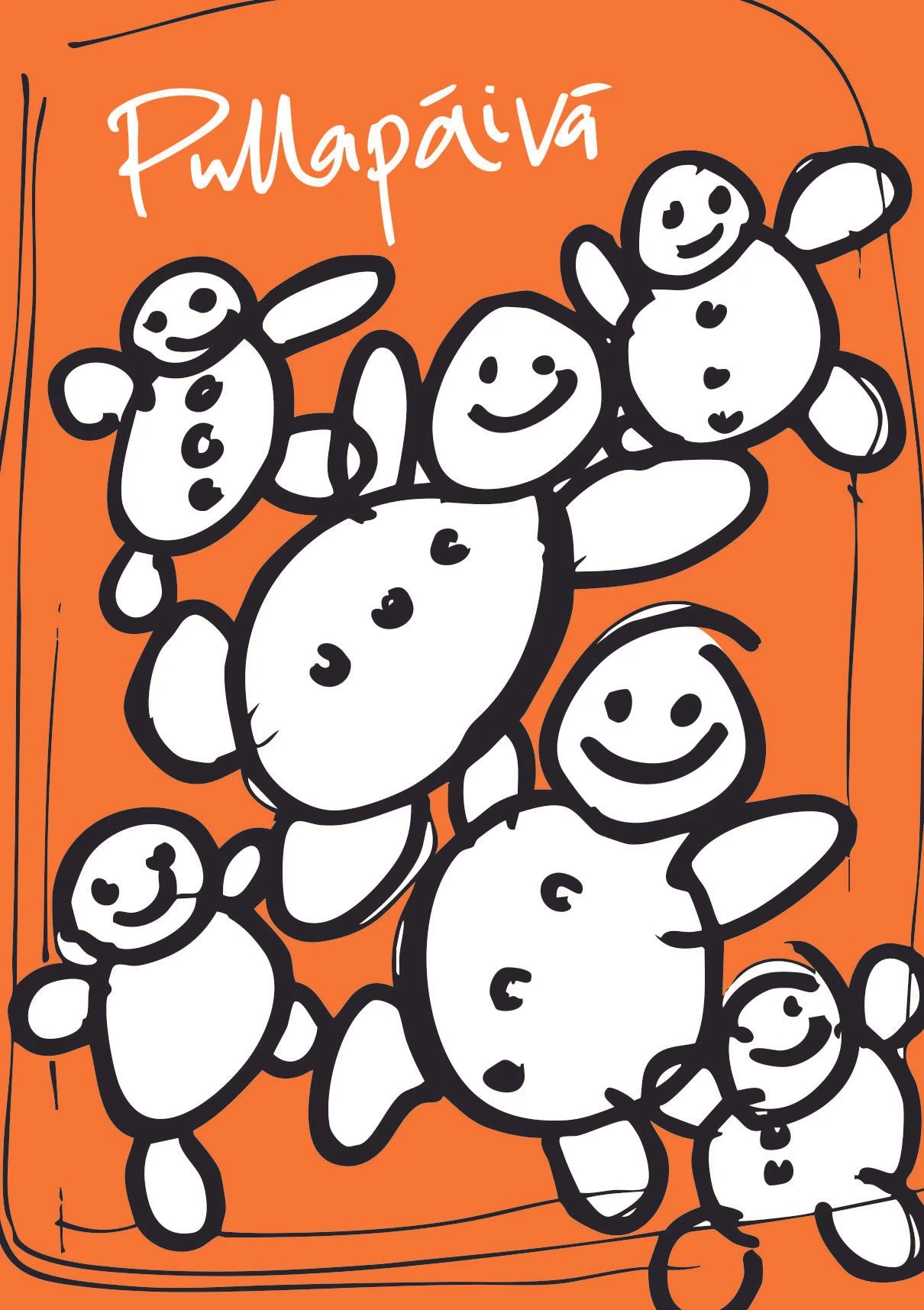
Pullapäivä
An informal community event connecting students, staff, alumni and working-life professionals.
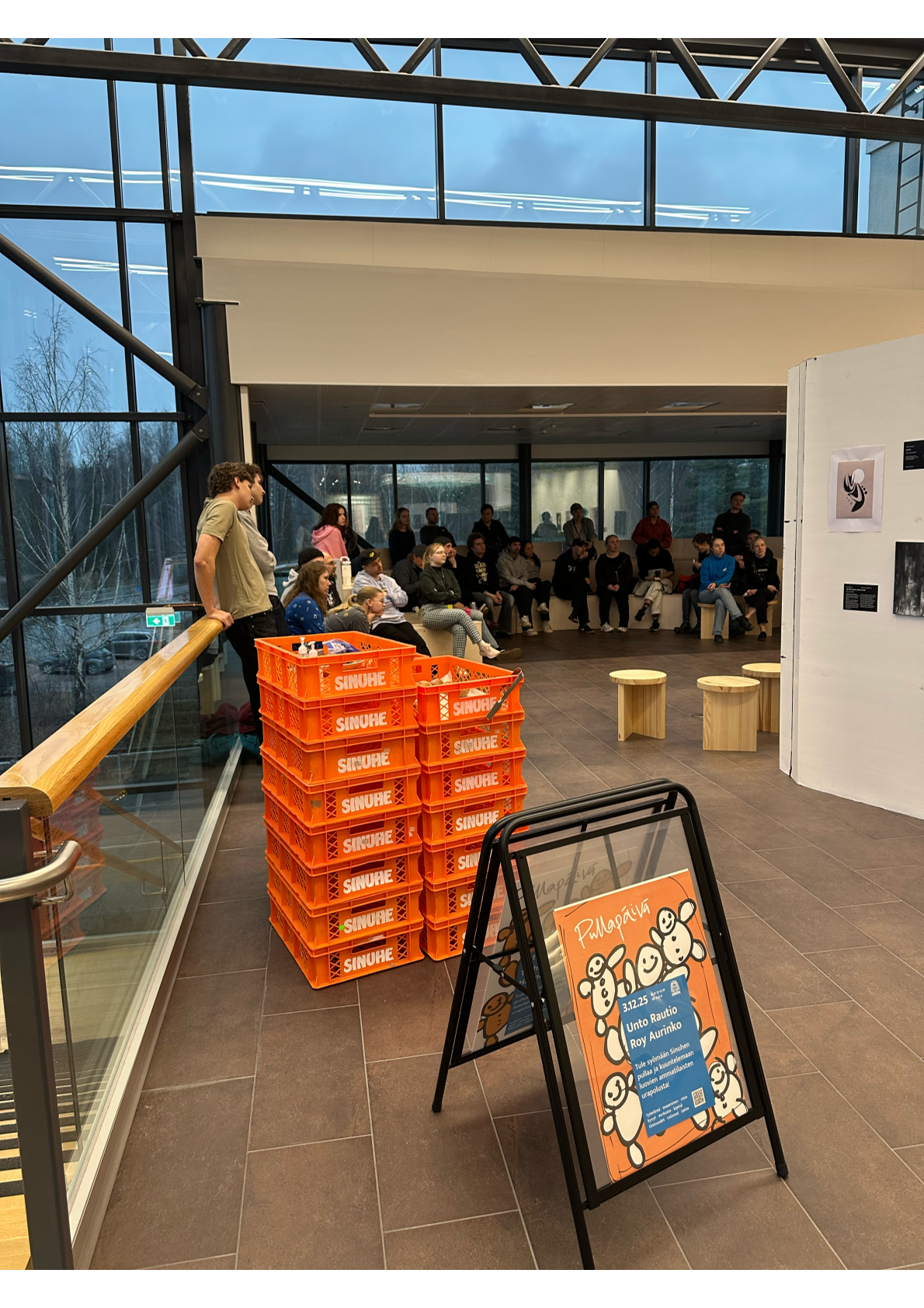
We designed and facilitated Pullapäivä as a low-threshold setting for meeting, sharing experiences and making connections between studies and working life more visible and approachable.
The informal format created space for conversations about careers, professional life and collaboration, while also bringing different parts of the LAB community together. The concept was developed iteratively, and participation grew from approximately 20 people at the first event to 60–80 participants.
The event also generated qualitative insights that complemented the project's other research and co-creation activities. Pullapäivä demonstrated how a simple, community-driven format can create meaningful connections between students and working life while supporting peer learning and professional identity.
Vuoden kierto
A concept for creating recurring moments throughout the academic year where students and staff could pause, meet and connect outside the regular rhythm of studies.
One concrete idea developed within Vuoden kierto was Kuusijuhla, a year-end gathering held in December 2025. It brought people together through seasonal traditions, shared activities, gingerbread decorating, Christmas songs, gingerbread and glögi. The event also created an opportunity for international students to learn about Finnish traditions and participate in a way that felt meaningful to them.
These four examples demonstrate how the project moved from broad student experience challenges towards digital service concepts, participation, community building and tangible experiences.
Outcomes
The project resulted in a set of prioritized development proposals that could be taken forward in different ways. Some remained as concepts, while others were developed into concrete activities and experiments.
Pullapäivä was implemented as a community event connecting students, staff, alumni and working life. Participation grew from approximately 20 people in the initial event to around 60–80 participants.
Kuusijuhla, developed as part of the Vuoden kierto concept, was implemented in December 2025 as a shared end-of-year gathering.
Other concepts, including Yhden oven takana and Kokemuskioski, remained as development concepts providing directions for future development.
The project demonstrated how service design could turn a broad and complex student experience challenge into concrete, actionable opportunities — from digital service development to community-building and new ways of involving students.
Reflection & Key Learnings
1 A complex service needs to be understood as a whole
The project reinforced how difficult it is to improve an experience by looking at individual touchpoints alone. Information, support, teaching, communication and community are interconnected parts of the student experience.
2 Participation can lead to tangible change
Working with students and staff helped move the project beyond identifying problems towards creating ideas that could be tested and implemented in practice. Some of the most tangible outcomes emerged from relatively simple opportunities for people to meet, participate and share their experiences.
3 Not every opportunity needs to become a finished solution
The 19 proposals covered a wide range of needs and possibilities. The project showed the value of creating a broad opportunity space first, while recognising that different ideas will require different levels of development, ownership and resources.
4 Service design connects strategic thinking with practical action
The project moved between understanding the wider student experience and designing concrete interventions. This balance — seeing the bigger system while still creating things that people can actually experience — became one of the most valuable learnings for me as a Service Designer.